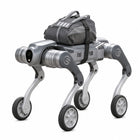
- 100 TOPS on Board The Flagship's high-computing-power module runs vision, mapping and learning models on the robot instead of an external computer.
- Navigation Ready From Day One A 3D LiDAR, two HD wide-angle cameras, obstacle avoidance and autonomous navigation are part of the configuration.
- Wheels and Legs Wheels give up to 5 m/s across campuses and corridors; legs handle steps of 20 cm or more and slopes of 30° or more.
- Small Enough for the Lab At 28.5 kg and 765 mm long it moves easily between teaching labs, offices and test areas.
- Long Test Days Three to five hours per charge, autonomous charging and manual battery replacement support repeated runs.
- Open for Development Secondary development support, Ethernet, USB and RS485 and 48 V and 24 V outputs take sensors, arms or a team's own computer.


Description
The Galileo C1-W Flagship Edition is the top configuration of Galileo's compact wheel-leg quadruped, with a 100 TOPS computing module on board for AI development. Perception, navigation and learning experiments run on the robot itself, in the lab or outdoors, instead of depending on a Wi-Fi link to a laptop or server.
The C1-W comes in four configurations: Basic, Smart, Smart with a 40 TOPS module, and Flagship. The Flagship keeps everything the Smart editions add, a 3D LiDAR, two HD wide-angle cameras, intelligent obstacle avoidance and autonomous navigation, and adds the 100 TOPS module, so a team starts from working autonomy and builds on it. The exact module and the software stack it supports are confirmed in writing with the quotation.
Wheels at the ends of its legs carry it at up to 5 m/s across campuses and corridors, and its legs take steps of 20 cm or more and slopes of 30° or more. It measures 765 × 480 × 540 mm, weighs 28.5 kg and carries 12 kg continuously. A 20 Ah, 960 Wh battery at 48 V gives 3 to 5 hours per charge, with autonomous charging or a manual battery swap.
An 8-core ARM processor with 8 GB RAM and 64 GB SSD runs the robot alongside the module, Galileo supports secondary development, and Ethernet, USB, RS485 and 48 V and 24 V outputs take arms, sensors or a team's own computer. The joints are rated IP67 for -20 °C to 55 °C. It is built for university embodied AI projects, SLAM and navigation work and onboard model testing in real environments.
Key Capabilities
- 100 TOPS on Board: The Flagship's high-computing-power module runs vision, mapping and learning models on the robot instead of an external computer.
- Navigation Ready From Day One: A 3D LiDAR, two HD wide-angle cameras, obstacle avoidance and autonomous navigation are part of the configuration.
- Wheels and Legs: Wheels give up to 5 m/s across campuses and corridors; legs handle steps of 20 cm or more and slopes of 30° or more.
- Small Enough for the Lab: At 28.5 kg and 765 mm long it moves easily between teaching labs, offices and test areas.
- Long Test Days: Three to five hours per charge, autonomous charging and manual battery replacement support repeated runs.
- Open for Development: Secondary development support, Ethernet, USB and RS485 and 48 V and 24 V outputs take sensors, arms or a team's own computer.
This model is offered on a quotation basis. Configuration, accessories, integration scope and delivery schedule all change the final figure, so pricing is confirmed per project rather than listed.
Buying through Robotix Market
This unit is sourced new through established distribution channels and ships worldwide with the manufacturer warranty. Technical support is coordinated with the manufacturer's own service network. Deployment scope, configuration, and commissioning responsibilities are agreed as part of the quotation, and on-site installation is not included in the product price.
Features
Specs
| Brand | Galileo |
|---|---|
| Model | C1-W Flagship Edition |
| Product Type | Compact wheel-leg quadruped robot |
| Edition | Flagship: Smart features plus a 100 TOPS computing module |
| Dimensions (L × W × H) | 765 × 480 × 540 mm (standing) |
| Weight | 28.5 kg |
| AI Computing | 100 TOPS module; exact module confirmed at quote |
| Main CPU | ARM 8-core / 8-thread, 8 GB RAM, 64 GB SSD |
| Perception | 3D LiDAR; two HD wide-angle cameras |
| Autonomy | Intelligent obstacle avoidance and autonomous navigation |
| Speed | 0 to 5 m/s, adjustable |
| Slope | 30° or more |
| Stairs | Consecutive steps of 20 cm or more |
| Continuous Load | 12 kg |
| Battery | Lithium, 20 Ah, 960 Wh, 48 V |
| Runtime | 3 to 5 hours |
| Charging | Autonomous charging and manual battery replacement |
| Standby | Low-power mode of 365 days or more, remote wake-up |
| Interfaces | Ethernet, USB, RS485; 48 V and 24 V power outputs |
| Wireless | Dual-band Wi-Fi 6 |
| Development | Secondary development supported |
| Protection | IP67 joints |
| Operating Temperature | -20 °C to 55 °C |
| Software Stack | Confirm at quote |
| Warranty | 12 months |
Industries
Frequently Asked Questions
The top configuration of Galileo's compact C1-W wheel-leg quadruped, with a 100 TOPS computing module for AI development.
It adds the 100 TOPS module. The LiDAR, obstacle avoidance and autonomous navigation are shared with the Smart editions.
The module is rated at 100 TOPS. The exact model and the software stack it supports are confirmed in writing with the quotation.
Up to 5 m/s on wheels, with 12 kg carried continuously.
Yes. Galileo supports secondary development on the C1 series, with Ethernet, USB and RS485 ports and power outputs for added hardware.
It is offered by quotation. Configuration, quantity and delivery are confirmed per project.
Recently Viewed
You haven't viewed any products yet.